
RE:WARD
From Static Symbol to Living Celebration
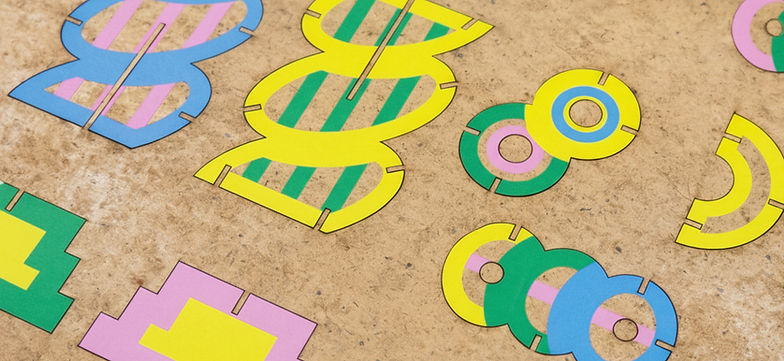
RE:WARD transforms the trophy from a fixed object into a living, evolving celebration. Conventional awards stand as motionless symbols — final markers of achievement. RE:WARD shifts this paradigm, turning recognition into a dynamic and evolving experience.
RE:WARD reframes recognition as a collaborative and regenerfibers, the trophy begins as a modular die-cut system. Instead organization a pre-assembled form, the organization die-cut system. Instead of presenting a pre-assembled form, the organization or award curator constructs the trophy configuration according to the theme, values, or narrative of their event. Each ceremony shapes its own distinct interpretation from the same circular material foundation.
Upon receiving the award, the recipient is invited to reconstruct and reinterpret the modular components, allowing the trophy to continue evolving beyond the ceremony.
This dual-stage assembly reflects achievement itself — shaped by collective vision and redefined by individual growth. Waste material gains renewed purpose; recognition becomes participatory and enduring. What emerges is not a static symbol, but an active dialogue between institution, recipient, and sustainable material transformation.
Can a trophy become a medium for transformation — of material, of value, and of the relationship between giver and receiver?

Value Transformation
Waste paper → new material
→ trophy
A low-value discarded material is transformed into an object worth keeping and treasuring.
Shared Making
The trophy is not simply bought and given. It invites the giver to take part through assembling, customising, or DIY involvement.
Giving & Receiving
The focus is not only on the recipient, but also on the giver. Both the act of giving and the act of receiving become part of the design itself.
RE:WARD
Material:
Regenerative
Sheet
Paper is a familiar carrier of messages and memory. Recasting it into a trophy gives discarded information a second life as recognition.
The Craft of the Press
The production of these panels feels more like a refined craft than a heavy industrial process. It begins with a "pulp," a mixture of recovered paper fibers and water. This organic slurry is then subjected to intense mechanical pressure and heat, allowing the natural bonding properties of cellulose to do what synthetic adhesives do in other materials. The result is a firm, stable, and surprisingly durable board crafted entirely from repurposed fibers.
This is what sets it apart. Many conventional board materials rely on synthetic adhesives or formaldehyde-laden resins to bond their layers and achieve structural integrity. This material takes a fundamentally different approach, one where nothing is added and what you see is what it is. The cellulose itself does the work. It is a process that respects the integrity of the raw material as much as the finished product.
As we look toward a greener, more inclusive industrial landscape, the humble paper fiber might just be our most valuable resource yet.
Rethinking the Monomaterial
At the intersection of industrial design and circularity, we have engineered a new solution: the regenerative sheet.
The concept is rooted in "material honesty." Most traditional construction boards—such as MDF or plywood, rely on synthetic resins and toxic glues to hold their fibers together. While these additives provide durability, they also make the boards incredibly difficult to recycle at the end of their life, often turning them into permanent waste.
By contrast, Regenerative Sheets are a 'monomaterial.' They are crafted entirely from repurposed paper fibers, utilizing the natural bonding properties of cellulose. The result is a high-performance alternative to traditional corrugated board, MDF, and timber panels. Because they contain no mixed-material contaminants, these sheets can be endlessly re-pulped and reborn, maintaining a truly closed-loop lifecycle.


